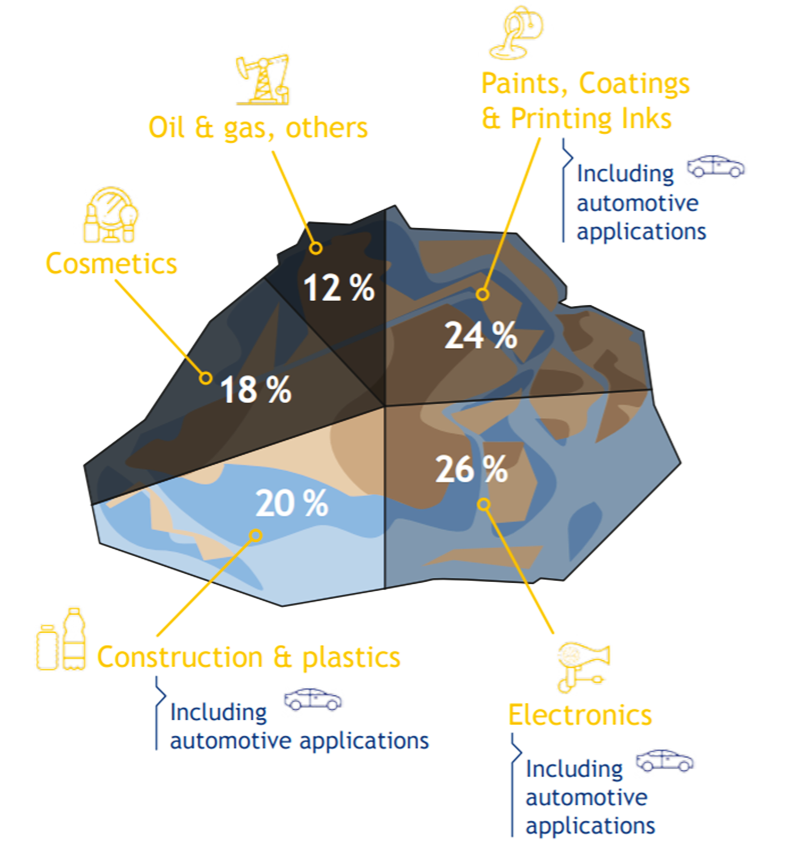
Industrial and Electrical Applications
In the industrial sector, mica is pivotal due to its insulating properties and heat resistance. It is commonly
used in electrical components for insulation, particularly in high-temperature environments like furnaces and
electrical heating appliances. In electronics, mica is used in capacitors, primarily in high-frequency and
radio-frequency applications, owing to its excellent dielectric strength. Furthermore, it is incorporated into
electrical cables in heavy industries to enhance fire resistance and durability.
Construction and Paint Industry
Mica finds significant use in the construction industry, especially in the production of joint compounds for
drywall. Here, mica acts as a filler and extender, providing a smooth consistency and resistance to cracking. In
the paint industry, mica is used as a pigment extender that enhances suspension, reduces chalking, and increases
the resistance of the paint film to water penetration and weathering. The reflective and refractive properties
of mica also contribute to the brightening of colored pigments in paint.
Cosmetics and Personal Care Products
The cosmetics industry greatly values mica for its shimmering qualities. It is a key ingredient in many makeup
products, such as blushes, eyeshadows, and lipsticks, where it adds a sparkling or pearlescent effect. Mica’s
reflective and refractive properties make it an essential component in these products, enhancing their aesthetic
appeal. Additionally, it is used in personal care products like moisturizers and toothpaste, providing a
glittery shimmer.
Automotive Industry
In the automotive sector, mica is used as an extender and filler in plastics, particularly in parts designed to
suppress sound and vibration. Its thermal stability and strength make it a suitable material for reinforcing
plastics used in automotive components. Mica-reinforced plastics are known for their high-heat dimensional
stability, reduced warpage, and improved surface properties.
Other Miscellaneous Uses
Beyond these primary industries, mica has a range of other applications. It is used in the production of roofing
materials due to its resistance to weather conditions and its ability to prevent sticking of adjacent surfaces.
Mica is also employed in the agricultural sector, where it is used in soil conditioners to improve soil
properties. In the science and technology sector, mica is used in atomic force microscopy for its flat surfaces
and as a substrate in the production of ultra flat, thin-film surfaces.
